A story told in games
Denys Khachatrian

The games that made me

Every game I've built carried something from the last one. A fascination. An obsession. A question I couldn't stop asking. This is the thread that connects a post-apocalyptic city to the open sea to the edge of space.

Scroll to begin
Chapter One

CrimeCraft

2006 – 2011 · Vogster Entertainment · Unreal Engine 3

It started with a city on fire. Sunrise City — a persistent-world MMO shooter where gangs replaced governments, economies ran on reputation, and every bullet mattered because the world never stopped. Published by THQ. Built on Unreal Engine 3. Shipped globally with two expansions.

This was the school. Not of code — I'd been writing that since 2000, from RenderMan shaders to custom DX9 engines. This was the school of scale. Of understanding what it takes to make a world that thousands of people live inside simultaneously. Trade systems. Loot economies. Gang territory control. Content pipelines that never sleep. The moment you ship an MMO, you learn that a game isn't a product — it's a living organism.

CrimeCraft taught me that the most beautiful engineering is invisible. Players never see the servers. They feel the world.

The persistent world stayed with me. But I wanted something purer — a simulation so precise that even the people living the real thing would trust it.

Chapter Two

RaceRoom Racing Experience

2011 – 2013 · SimBin Studios AB · Lead Developer

From the chaos of gang warfare to the precision of a braking point at 280 km/h. SimBin Studios — one of the most respected names in sim racing — brought me in to lead their headline project. The task: build a game-as-service racing framework from the ground up.

What we created became RaceRoom Racing Experience. A free-to-play simulator so authentic that professional DTM and WTCC drivers use it for training. Eurogamer would later call it the best racing game most people had never heard of. Over a decade later it's still running, still being updated, still fast. 11,000+ Steam reviews.

The lesson was about fidelity as an art form. When you model tyre physics well enough that a real driver nods — that's not engineering. That's craft. The gap between simulation and reality is where beauty lives.

I'd built a persistent shooter world. I'd built a precision simulator. What happens when you try both at the largest scale imaginable?

Chapter Three

Battlefield

2013 – 2014 · EA · DICE · Easy Studios · Studio Technical Director

You've played it. I can't show you the screenshots — it's EA, you know how it is — but you've played at least one game from at least one franchise I worked on. You know you have.

Studio Technical Director at DICE. The biggest stage in gaming. Not a place for small ideas. A place where every system operates at a scale most engineers never encounter, where the technical challenges exist because nothing has ever been built at this resolution before.

What I took from it wasn't about the size of the budget or the brand on the box. It was a confirmation: the best technology is invisible. Sixty-four players sprinting across a collapsing building don't think about the netcode. They feel the moment. And that moment — that's what all this engineering is for.

I'd seen how the biggest studios in the world build games. Now I wanted to build a studio. And I wanted to build games where the wind itself is a character.

Chapter Four

Naval Action

2014 – present · Game Labs · Co-Founder & Vice President

We co-founded Game Labs to make the games we always wanted to play. The first obsession: the Age of Sail. Not the romantic version. The real one — where yard angles matter, where the wind is your enemy, where a ship is a machine of 10,000 decisions.

Naval Action became a game where even the waves are calculated on the server — making hacking impossible by design. Fifty historically accurate warships. Realistic ballistics. A player-driven economy built around clans, ports, and trade routes that span the entire Caribbean. Steam named it one of the best Early Access releases of 2019.

It was, at its heart, a love letter to simulation. The same instinct that drove RaceRoom — that obsessive need to close the gap between the virtual and the real — but now applied to canvas and cannon. The patience of a 45-minute battle. The beauty of a first-rate ship-of-the-line catching the wind at dawn.

We'd mastered the sea. We'd shipped strategy games that PC Gamer called among the 20 best wargames of all time. But what kept pulling at me was land — wild, procedural, alive.

Chapter Five

This Land Is My Land

2019 – 2022 · Game Labs · 100 sq mi open world

A hundred square miles that never generate the same way twice. Cities that grow. Railways that spread. Patrols that learn your patterns and adapt. An AI that doesn't follow scripts — it observes, thinks, responds. This was the most ambitious thing we'd ever built.

This Land Is My Land was a stealth action game on paper, but in practice it was an experiment in emergent storytelling — what happens when you drop a single person into a world that has its own plans? The world doesn't wait for you. It develops. It evolves. It fights back.

And then the real world fought back too. In February 2022, Russia invaded Ukraine. Our team — a small group of addicted developers from Kyiv — had to pause development to save their families. Some went to war. The game froze in time. But the lesson it taught me didn't.

The lesson: a world that lives without you is the most beautiful kind of world to build.

The frontier obsession didn't die. It deepened. The same era, a new angle — what if you weren't resisting the frontier, but surviving it?

Chapter Six

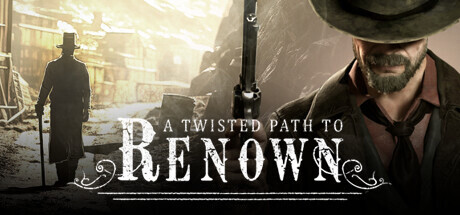
A Twisted Path
To Renown

2024 · Game Labs · PvEvP Extraction Shooter · 1899 America

Same team. Same era — 1899, the dying breath of the American frontier. But this time: first-person. Extraction-based. A world where your gun behaves exactly like its historical counterpart — ballistics, smoke, reload mechanics — and where every raid could cost you everything you've built.

A Twisted Path To Renown was the convergence of every thread: the persistent economy from CrimeCraft, the simulation fidelity from RaceRoom, the living world AI from This Land Is My Land. Homesteads. Farming. Mining. Trading. An extraction loop wrapped around a frontier sandbox.

It launched. It reached 1.0. And then, like so many ambitious things, it ended. Closed. Removed from Steam. A chapter complete. Not every story gets a sequel — but every story teaches you how to write the next one.

For twenty-five years, every game pulled me toward the same questions: what makes a world alive? What makes an economy breathe? What makes logistics beautiful?

I finally stopped answering them for other people.

Chapter Seven · Now

Void Logistics

A 2.5D sci-fi space logistics and strategy game. Factorio meets X4 meets OpenTTD meets Space Rangers — automated production chains, interstellar trading with supply-demand economics, procedural planetary systems, faction warfare, and a universe that ticks whether you're watching or not.

Built solo. Unity 6 with ECS/DOTS. Custom rendering pipelines. Procedural planet generation. GPU-driven detail scattering. A technology tree with hundreds of nodes. Behaviour trees for AI factions. Energy grids. Conveyor systems. DNA genetics for individual characters. A save system that serialises entire worlds.

Every system I've ever built — from the persistent economies of CrimeCraft to the simulation physics of RaceRoom to the living worlds of This Land — flows into this. This is the game all those other games were training me to make.

Unity 6.3ECS/DOTSURP 17.2Burst Procedural PlanetsGPU ScatterSupply-Demand Economics Behaviour TreesCustom ShadersSolo Dev

Making games isn't a career. It's a way of seeing. Every game is a lens — a new way to look at systems, at beauty, at what makes a world worth inhabiting. If you're building something and you don't know where it's going — keep building. The thread reveals itself.